I maintain a private loan ledger app for a small lending business. It holds borrowers, principal, monthly interest, and the reminders that go out when a month is missed. The diagrams here are drawn from the code instead of screenshots.
I cut 1.5.1 and 1.5.2 in the week of 17 November. The first rebuilt the Home screen around two money views, reworked the theme tokens and typography, and added a whole-book Overview page. The second shrank the Android build and set up over-the-air updates. The ledger work kept running into the same problem: a rupee has two dates.
The first of the month was wrong
Interest for a month is due in the first three days of the next one. Every screen depends on that sentence. money.ts holds the constants: SHORT_RATE = 6, LONG_RATE = 2, DUE_DAY_START = 1, DUE_DAY_END = 3. A short loan accrues 6 percent a month. A long loan accrues 2 percent, paid yearly or when the loan closes.
The Home screen had a card for this month’s interest. On 1 November it read zero collected against November’s expected amount. November’s payment window is 1 to 3 December, so no November money could have arrived yet. The money arriving that morning was for October, and the card did not look at October. I had built a card around the due month and then read it as if it were the cash month.
resolveMonthState returns one of five states. A recorded payment wins, then future, awaiting, pending or delayed as the month and its window move.
export function resolveMonthState(
  dueMonth: string,
  paidOn: string | null,
  today: Date
): MonthState {
  if (paidOn) return 'paid';
  const nowKey = monthKey(today);
  if (dueMonth > nowKey) return 'future';
  const windowKey = dueWindowMonth(dueMonth);
  if (nowKey < windowKey) return 'awaiting';
  if (nowKey > windowKey) return 'delayed';
  return today.getDate() <= DUE_DAY_END ? 'pending' : 'delayed';
}
awaiting is what makes a mid-month loan fair. A loan given on 28 October has October interest, and October’s window is 1 to 3 November, so it is not late on the day it starts. Without that state the grid would paint a new borrower red immediately.
Each loan gets a month cell from its start month to lastDueMonth: the current month for an open loan, the close month for a closed one. The expected amount is monthlyInterest(loan.amount, loan.rate), not a stored number, so a corrected principal flows through every cell.
The fix was small once the model was right. computeDashboard gained shortInterestDueLastMonth and shortInterestCollectedForLastMonth, computed from the month cells and from payments whose due_month is last month. CashSummary takes the due amount, the collected amount and the month label, and keeps the cash figure on the current calendar month. The interest half opens month-payments for last month with scope=interest; the cash half opens the current month with scope=received. Tapping either half opens the month it is actually reporting.
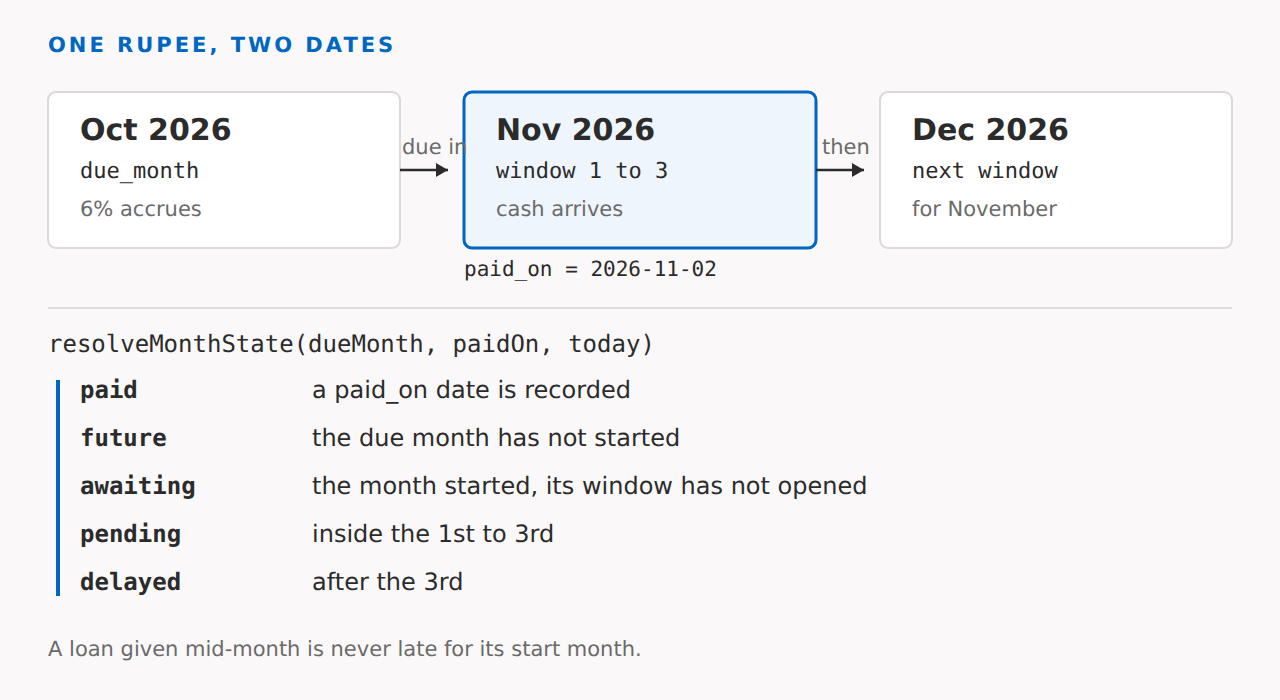
How a due month moves from future to awaiting, pending, delayed or paid.
Every rupee once
The new Overview page is a book statement, not another Home. Every rupee appears once. Principal is a stock, lending and closing are flows, and cash is what actually landed. The old page mixed them, so the same rupees could show up in more than one headline.
computeOverview returns them separately. totalLent is all-time principal, split into closedPrincipal, principalShort and principalLong, which add back to the total. principalOut is the active principal. The month’s movement is one identity: openingPrincipal = principalOut - lentThisMonth + closedThisMonth. That identity keeps the opening and closing figures in agreement.
The risk block only counts short-term dues. totalDue = overdueAmount + inWindowAmount, and the overdue part is aged by daysPastDeadline, which measures from dueDeadline(dueMonth), the third of the following month. The buckets are 30, 60, 90 and older. The day count uses Date.UTC(y, m - 1, d) on both ends, so a daylight-saving shift cannot move a payment into the next bucket. arrearsMonths is overdueAmount / shortMonthlyRunRate, which turns rupees into months of collection.
The long-term side had a bug. It counted payment rows, so a borrower who paid a year’s interest in one transfer looked like they had settled one month and owed eleven. The new code accrues every month from the start to today, subtracts the money actually received, and floors the result at zero. A test fixture sets 21 months at 2,000 and one 24,000 payment and expects 18,000 still accrued. Another test pins the case where a due month is paid early and the cash belongs elsewhere.
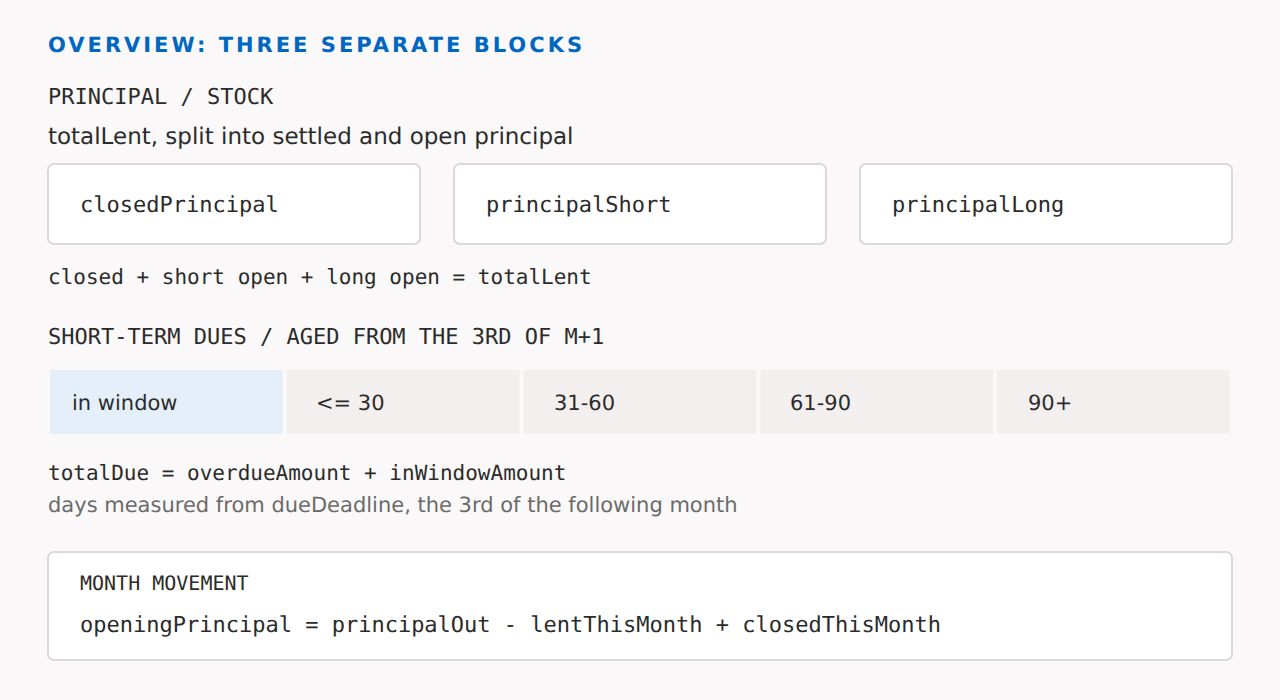
The three blocks on Overview and the arithmetic that keeps them from overlapping.
The design is in docs/OVERVIEW-DESIGN.md, which keeps the rejected versions too. A second collection queue lost because Home already owns the chase list, and a three-chip scope switcher would hide the whole-book totals behind a tap.
Money writes go in one batch
The database is Turso, libSQL over HTTP. It has no interactive transactions, so a multi-statement change cannot be rolled back by hand. The atomic unit is db.batch(statements, 'write'), which sends the list as one write. Every money change goes through it.
Marking a month paid is an upsert plus an audit row. The upsert targets (loan_id, due_month) where kind = 'interest', backed by the partial unique index idx_payments_interest_month. The insert creates the row if it is missing and updates it otherwise. The second statement appends a paid event with the amount and the date that was actually recorded. Both are in one batch, so an audit entry cannot exist without its payment, or the other way round.
Undo is the more interesting one. It does not delete the row. It writes an unpaid event by selecting from payments where paid_on IS NOT NULL, then clears paid_on in the same batch. The INSERT ... SELECT means a second undo writes no event, because the select returns nothing. The month goes back to pending or delayed, totalPaid drops, and the history still shows that the payment existed and was reversed. A lender will sometimes mark the wrong month. The history should show the correction instead of erasing it.
Reads fail differently. listPeople loads people, loans and payments in three queries and groups them in memory. When the network is down, listPeopleOffline returns the last snapshot from readPeopleCache and sets an offline flag. Writes still need a connection; there is no write queue. I preferred a visible offline read over a silent write that might never land.
Shipping updates without a cable
Version 1.5.2 carries expo-updates with the appVersion runtime policy. app.json sets runtimeVersion to the appVersion policy, and eas.json gives the production build the production channel and an APK. The APK’s runtime version equals its app version, currently 1.5.2. A JS or asset-only change ships with npx eas-cli update --branch production --message "..." and lands on launch. A native dependency, permission, config plugin, icon or splash change needs a new build, because the runtime version moves with the app version.
The same release had a dependency conflict. npm ci failed on reanimated 4.7.1, which wants worklets 0.13, while Expo 57 allows worklets 0.10. The fix was to pin the pair that matches the SDK, 4.5.1 and 0.10.1.
I also deleted an unused SVG chart and the native react-native-svg package, expo-linear-gradient, five unused font weights and the starter assets. ProGuard, resource shrinking and minification were already on; 1.5.2 added legacy native-library packaging and JS bundle compression. A config plugin, withArm64Only, writes abiFilters 'arm64-v8a' into build.gradle and sets reactNativeArchitectures to the same value, so the APK carries one set of native libraries instead of four. npx expo prebuild stays reproducible because the change is a plugin, not an edit to android/.
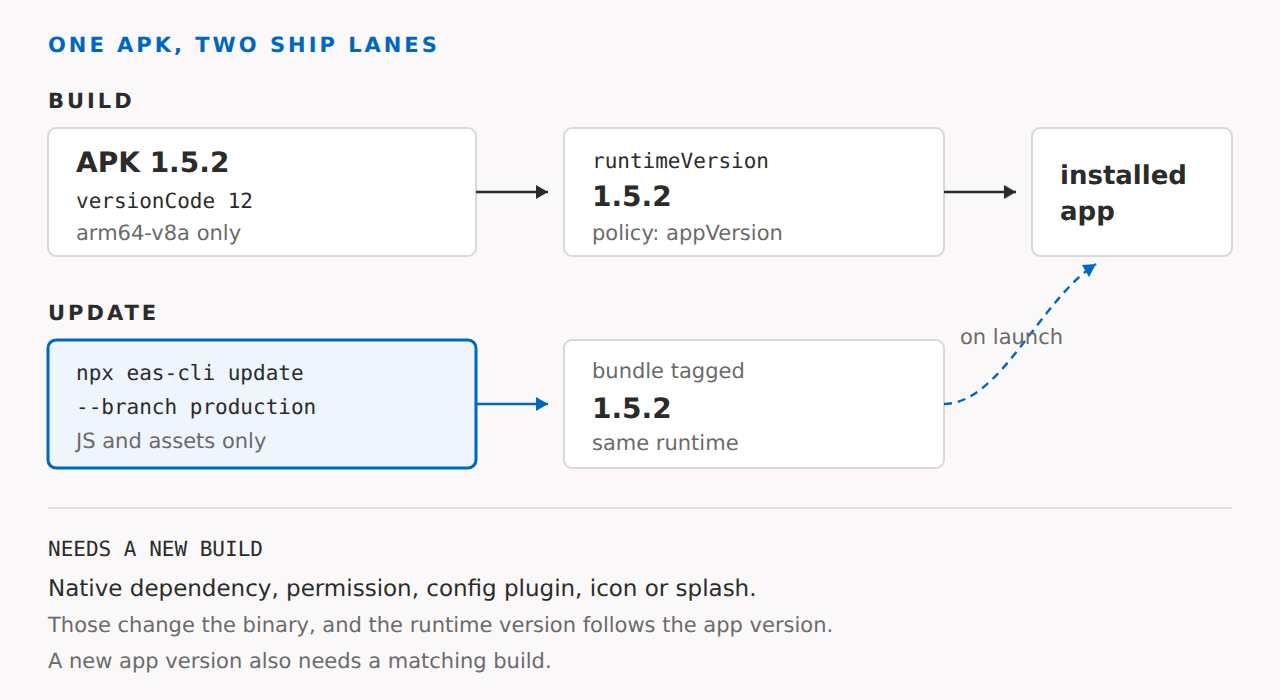
What can ship over the air and what still needs a new APK.
The tradeoff is that an old 32-bit phone cannot install the APK, and Android is the only build profile in the repo. For the phones this app runs on that is fine, but I have to remember it when someone asks for the app.